








The U.S. National Park Service is known for its preservation of historic homes, monuments, and beautiful wild landscapes across the country: the Statue of Liberty, the Grand Canyon, and Yellowstone’s Old Faithful geyser immediately come to mind.
And then there are the spectacular forests. Great Basin National Park showcases ancient bristlecone pines which have been calculated to be 5,000 years old. They may be our nation’s oldest trees, but the tallest trees are the Coast Redwoods, located in Redwood National Park. And the largest living tree by volume – not just in our national parks, but in the world – is the General Sherman Tree in Sequoia National Park.
But perhaps fewer people are aware that orchards, also, are a significant part of the NPS portfolio of cultural assets. From apples to plum trees, and from peach groves to pecans, the agency is the custodian of an array of living agricultural history. (In fact there are other parks in the system that wrangle cattle and herd goats – but that’s another story.)
The NPS website explains why fruit and nut trees are a part of its work: “Old trees are a living connection to the people who shaped agricultural, domestic, commemorative and designed landscapes.”
So with the hoopla of the nation’s 250th birthday beginning to fade in our rear view mirror, let’s take a moment to dig into some of this quieter arboreal history and see what it has to tell us about less well-known aspects of our country’s past.
For example, Martin Van Buren bought Lindenwald, a rural estate in eastern New York State, while he was still serving as the nation’s eighth president. Early on, he directed the planting of several thousand apple and pear trees on the property, and after he completed his term in office, he focused heavily on fruit production as well as grafting different varieties onto rootstock.
At a time when apple growing was just beginning to become commercialized, historians conjecture that Van Buren was one of the earlier farmers to engage in widescale marketing of both apples and apple trees. The former president was interested in progressive farming and was keen on demonstrating that farming in the northern states was economically viable without requiring the use of enslaved labor.
This tied into his political stance against expanding slavery into America’s western territory. In fact, his growing involvement with the Free Soil Party – its slogan was “Free soil, free speech, free labor, and free men” – prompted him to run again for the presidency in 1848. He lost, but continued to promote progressive agricultural practices for the rest of his life.
By the middle of the last century, however, the native woodlands at Lindenwald had encroached upon the orchards and were choking out the fruit trees.
Even after the Martin Van Buren National Historic Site was established in 1974, it took a couple of decades of fits and starts for the National Park Service to come up with a plan, stakeholder approval, and the funding needed to rehabilitate at least part of the orchard.
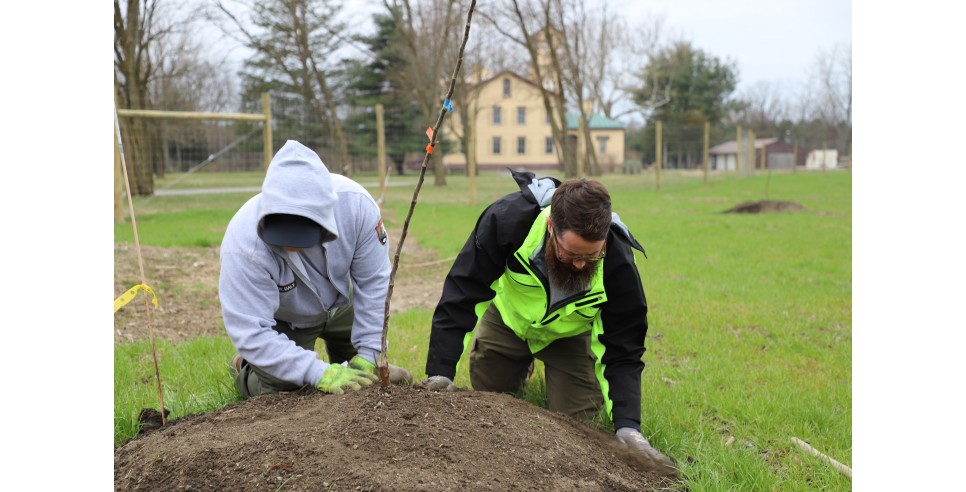
The replanting of the orchard began just two years ago, using historically authentic apple varieties and environmentally sustainable practices. Because the site is located on the traditional homeland of the Stockbridge-Munsee Band of Mohican Indians, NPS also consulted with the Mohican Tribal Historic Preservation Officer throughout the entire process to make sure the replanting did not interfere with indigenous cultural resources.
Across the country, a very different type of orchard is taking root in Canyon de Chelly National Monument, which is part of the homeland of the widespread Navajo Nation. Horticulturalist Reagan Wytsalucy is devoting her career to help bring back the traditional peach orchards of the Diné, Hopi, and Zuni peoples of the Four Corners region of the desert Southwest.
Until she was ten years old, Wytsalucy didn’t know that she herself was Native American. After that, she began to pay more attention to her heritage, learning about the notorious “Long Walk” that many of her ancestors had been forced to endure in 1864, when the U. S. Army forced the Navajo people off their land to make way for white settlers. To discourage anyone from trying to return, the Army obliterated indigenous food sources – burning their crops, slaughtering their livestock, and cutting down their peach orchards, which had been tended since the 17th century.
Once Wytsalucy went to college and started studying agronomy, she focused intensively on the peaches that had been such an important foodstuff and trading item for her ancestors. She started scouring sites in Utah, Arizona and New Mexico for the few residual trees that were reported to have survived against all odds. She collected not only precious samples but also invaluable stories from the few caretakers who had retained knowledge of the traditional way to cultivate these unique peach trees in such a dry, hot climate.
In concert with the National Park Service, Wytsalucy is working to reintroduce those heritage peaches on a larger scale in some of the places where they were traditionally grown, including Canyon de Chelly. The effort aims not only to restore a traditional food, but also to rekindle cultural knowledge and preserve an ecologically sustainable legacy.
Every site listed on the National Park Service’s map of historically significant orchards has a story to reveal. A row of pecan trees and a hedge of pomegranates are part of the gardening legacy at Mission Concepción, one of the churches included in the San Antonio Missions National Historical Park in Texas. On eastern side of Santa Cruz Island, which is part of Channel Islands National Park off the coast of California, an olive orchard that was originally planted 140 years ago as part of the Caire-Gherini Ranch continues to be managed for oil production.
Perhaps one of the most unexpected collection of trees under the care of the National Park Service is the coconut grove at Pu’ukohola Heiau National Historic Site in Hawaii.
This was the location of a major temple and King Kamehameha I’s royal residence. Coconut trees were valued for their many uses – food, fiber, medicine, tools and utensils, building materials for canoes or housing, and even weapons – so the size of a coconut grove was indicative of a king’s status. Until Kamehameha established his primacy as king of the Hawaiian Islands, rival chiefs would sabotage one other’s coconut groves – destruction of that valuable natural resource could cripple an opposing faction.
From rare to ubiquitous, the NPS finds itself the custodian of many, many remnants of apple orchards. These can be found on the grounds of historic lighthouses, forts, and the former homes of poets, inventors, settlers and presidents. Heritage apple varieties like Hawkeye, Red Duchess, Aunt Rachel, Horse, Esopus Spitzenburg – and literally hundreds more – contain a treasure trove of diversity that could provide unique traits for climate adaptation and resistance to disease in the years ahead.
So while it may not have the pizzazz of Mt. Rushmore or the Mammoth Caves, the National Park Service’s preservation of America’s fruit tree legacy is one well worth appreciating.
Barbara Lloyd McMichael is a freelance writer living in the Pacific Northwest. Check out her Pacific Rim Story Laboratory website.

Barbara McMichael
Barbara Lloyd McMichael is based in the Pacific Northwest and writes about books and culture. She writes a syndicated weekly book review column called “The Bookmonger” that focuses on Northwest books and authors. Her PR for People® Book Review is written exclusively for The Connector.