








I. Whatever happened to “Drain the Swamp”?
In May, Donald Trump’s post was cited in The Cultural Landscape Foundation’s lawsuit against the U.S. Department of the Interior. TCLF, a nonprofit group that advocates for the value of our shared landscape heritage, maintains that Interior violated federal law by failing to submit for review a change of paint color – from achromatic/gray to “American Flag blue” – for the basin of the Reflecting Pool on the National Mall.
If this sounds like a trivial fight over which crayon in the crayon box is the best color, let’s pause to, well, reflect on this a little more deeply.
The mirroring effect of pools of water has proven to be trouble since the times of Greek mythology. Remember what happened to Narcissus? After admiring his reflection and honoring his vanity at the cost of all else, the fellow was cursed to spend eternity as a daffodil.
Trump, the premiere narcissist of our time, had been boasting this spring about how his overhaul of what he called “the Reflecting Lake” between the Washington Monument and the Lincoln Memorial was – contrary to the efforts previous presidents had made to rehabilitate the massive waterwork -- “something that’s really going to be beautiful.”
At a Cabinet meeting on May 27 of this year, in a rambling screed, Trump spread his disparagement between the pool and his predecessors.
“It's embarrassing. It was so horrible. I never saw anything like it. It was filthy, dirty. It was Biden. And they spent, between the two of them, they spent hundreds of millions of dollars trying to fix this thing. Now, when Biden -- when Obama did it, he spent way over $100 million.”
The truth is, the Lincoln Memorial Reflecting Pool has been problematic since its inception. Architect Henry Bacon was commissioned in 1912 to design a memorial to honor Abraham Lincoln. It was also his idea to create the 2000-plus, footlong water feature to establish a compelling visual connection between the memorial he was creating, and the already-standing Washington Monument – two structures honoring what were then (and may still be) America’s two most consequential presidents. As America’s first president, George Washington established the crucial foundation for the customs and behaviors of the office, while seven decades later Abraham Lincoln abolished slavery and preserved the Union.
Bacon’s plans for the Lincoln Memorial included establishing a massive undercroft beneath the structure to keep the building from sinking into the reclaimed Potomac marshland it was being built upon. But he didn’t give the same engineering consideration to the Reflecting Pool which, with a capacity for holding over 6.5 million gallons of water, also ran the risk of sinking into the strata of soft soils.
Sure enough, after it was built and filled with water in 1923, the Pool proceeded to sink, developing cracks early on, leaking a prodigious amount of water over the years, and frequently being overwhelmed by algae.
It wasn’t until the Obama administration nearly 90 years later that a major $34 million restoration effort (not $100 million, as Trump claimed) was undertaken to fix the issues. The Pool was drained, pylons were installed to shore up the sinking infrastructure, and the base was replaced with treated concrete. A new water system sourced the pool water from the Tidal Basin rather than from the municipal water supply.
Despite this investment, problems persisted. Significant leakage continued and, in 2017, a die-off of four-score ducks at the Reflecting Pool was attributed to a parasite carried by snails in the pool. The Pool was drained once again – this time to eradicate the snails.
In April of this year, the Trump administration announced that it would be undertaking a beautification project to repaint the bottom of the Pool before America’s 250th birthday celebration. Known for working fast on matters that personally interest the President (remember the East Wing?), the administration awarded a contract, without going through the customary bidding process, to a contractor who never had attempted a project of this scope.
Experts had advised that such a project would take a couple of years to complete, but Trump wanted to pull it off in a matter of weeks, and certainly before America’s 250th birthday party. Having built pools at his resorts, Trump confidently authorized the use of a commercial swimming pool liner for this project. The budget: $1.8 million.
This quick-fix approach, coupled with a stretch of bad weather, may have meant that not enough time was allowed for the sealant used on the Pool to cure properly.
After the repainting, but before the Pool was refilled, a motorcade carried Trump and others down the length of the Pool so that the President could inspect the work. It got the thumbs-up.
Alas, once refilled with water, the Pool’s algal bloom returned with a vengeance. Crews were quickly dispatched to wade into the water and vacuum algae off of the Pool floor. Gallons of hydrogen peroxide were dumped into the water to try to kill the algae. An ozone nanobubbler was installed to help purify the water.
Final price tag: over $16 million. Oops.
But that’s not the end of the story.
Pieces of the commercial pool liner began to peel off the Pool’s floor, and in recent weeks onlookers may have been drawn to the site less to reflect upon the virtues of our venerable past leaders, than to watch the latest chapter of this environmental debacle unfold.
Some folks are even being arrested and indicted for having the audacity to touch the water in this public park. Or to finger the floating debris.
The Trump administration’s response to this botch-up has been testy. Hurling accusations of sabotage, it has refused to entertain any alternative explanations for these unanticipated complications, such as:
1.) the rushed application of a slow-drying pool epoxy could have led to these problems, or
2.) it was faulty to assume a pool liner could overcome deeper structural problems, or
3.) driving a presidential motorcade across the freshly-treated pool bottom might have had anything to do with this most recent pool failure.
On America’s 250th birthday, a chain link fence barricaded the public from accessing the Lincoln Memorial Reflection Pool.
So: there was much ado about everything and anything (– other than the Epstein files).
II. Reflecting on dreams
Years before the Lincoln Memorial project was funded, architect Henry Bacon worked and dreamed and planned for this assignment. Although Illinois-born, Bacon’s travels through Europe as a young man had kindled his enthusiasm for the classical architecture of Greece. And it was nothing less than the Parthenon that inspired his design for the Lincoln Memorial – for if Greece was the founding place of democratic ideals, surely Lincoln was America’s 19th century champion of democracy.
When the site was finally approved and funding for the Memorial was secured, there was a modest ceremonial groundbreaking on the anniversary of Lincoln’s birthday – February 12 – in 1914. Construction began in earnest the following month.
The architect insisted on sourcing building material from around the country, a quiet tribute to Lincoln’s commitment to reunite a fractured nation. So the granite came from Massachusetts, the limestone from Indiana, and different marbles were sourced from Alabama, Colorado, and Tennessee. Bacon designed a colonnade of 36 fluted Doric columns to surround the Memorial – these represented the 36 states that were in the Union at the time of Lincoln’s death. Likewise, the names of the states, and the dates of their entry into the Union, were inscribed in a frieze above the colonnade.
Although the National Park Service insists that this is strictly coincidental, there are 87 steps leading down from the main platform of the Lincoln Memorial to the Reflecting Pool – that’s the same number as the “four score and seven years ago” Lincoln famously referenced in his Gettysburg Address. The text of that Address and a selection of Lincoln’s other famous orations are inscribed on the interior walls of the Memorial.
The marble for the 19-foot-tall sculpture of a seated Abraham Lincoln, carved by Daniel Chester French, came from the state of Georgia. Lincoln looks pensively out across the Reflecting Pool toward the Washington Monument in the distance – conveying a nod of acknowledgment to the past, a humble consideration of his own work, and a meditation on what was yet to come.
And boy, has there been a lot.
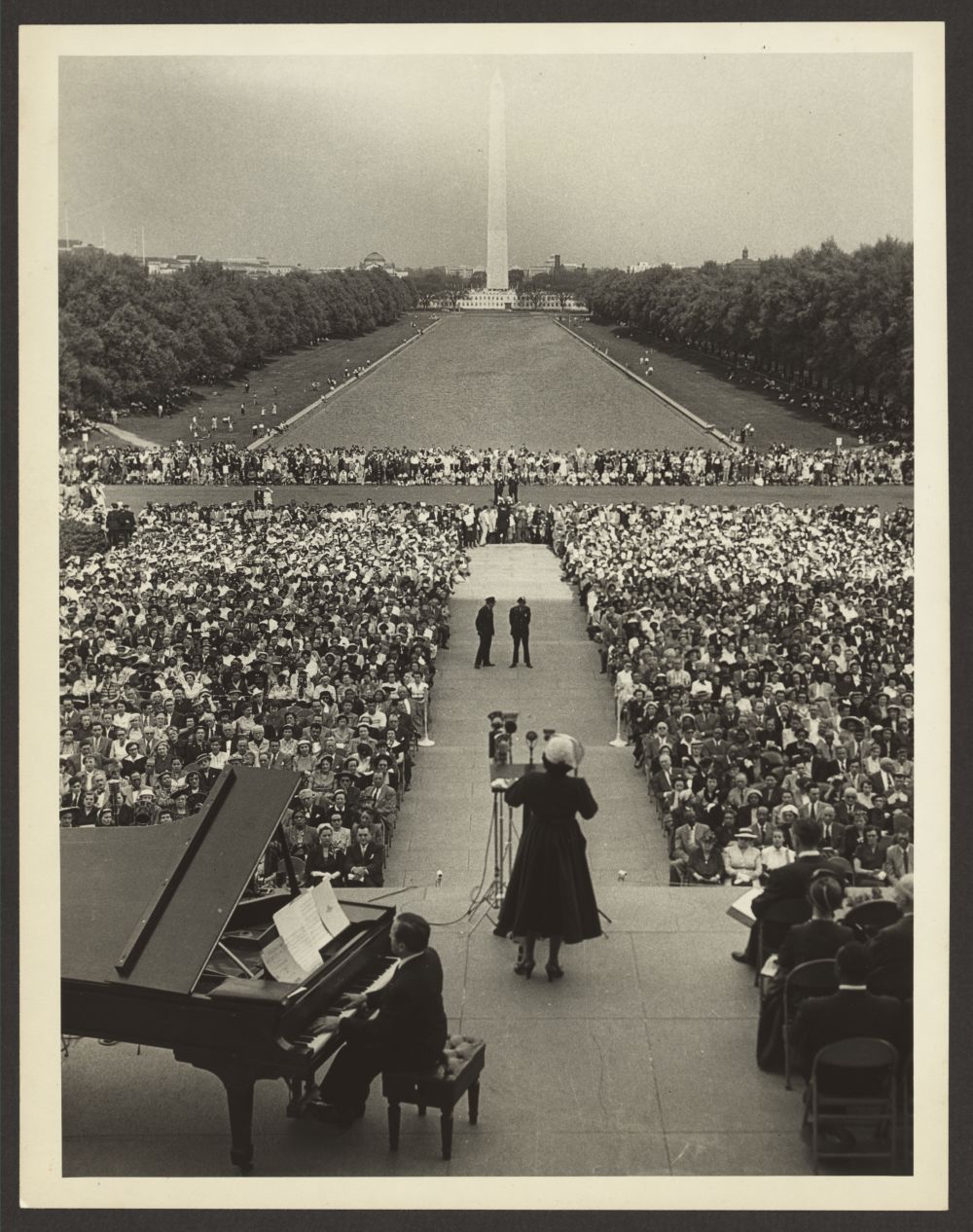 In 1939, opera singer Marian Anderson’s voice would ring out over the Reflecting Pool in an historic Easter Sunday open-air concert before 75,000 audience members. The concert had been arranged by First Lady Eleanor Roosevelt after the Daughters of the American Revolution denied Anderson access to their stage at Constitution Hall because she was Black.
In 1963, Martin Luther King would call out to the 250,000 people gathered at the base of the Lincoln Memorial steps and stretched far down along the Reflecting Pool, to encourage them with his “I Have a Dream” sermon.
These gatherings have continued: the March on the Pentagon, the Poor People’s Campaign, the March for the Equal Rights Amendment, the Million Man March, the AIDS March, the Women’s March, the People’s March, No Kings….
It’s been a little over a century since the Lincoln Memorial and the Reflecting Pool were built, and now it’s been generations of folks who have come together at this hallowed place to pay their respects and to reflect on what their role can be in advancing the proposition that all are created equal. Is it foolish to believe that some of those invocations, those chants, those melodies, and those dreams may have slipped into the still, green waters of the Reflecting Pool, and sifted down through the algal muck on the bottom, and seeped through the pool’s cracks… and replenished the wellsprings of hope?
III. An interlude with the denizen of Walden Pond
“A field of water betrays the spirit that is in the air. It is continually receiving new life and motion from above. It is intermediate in its nature between land and sky.” – Henry David Thoreau, “Walden”
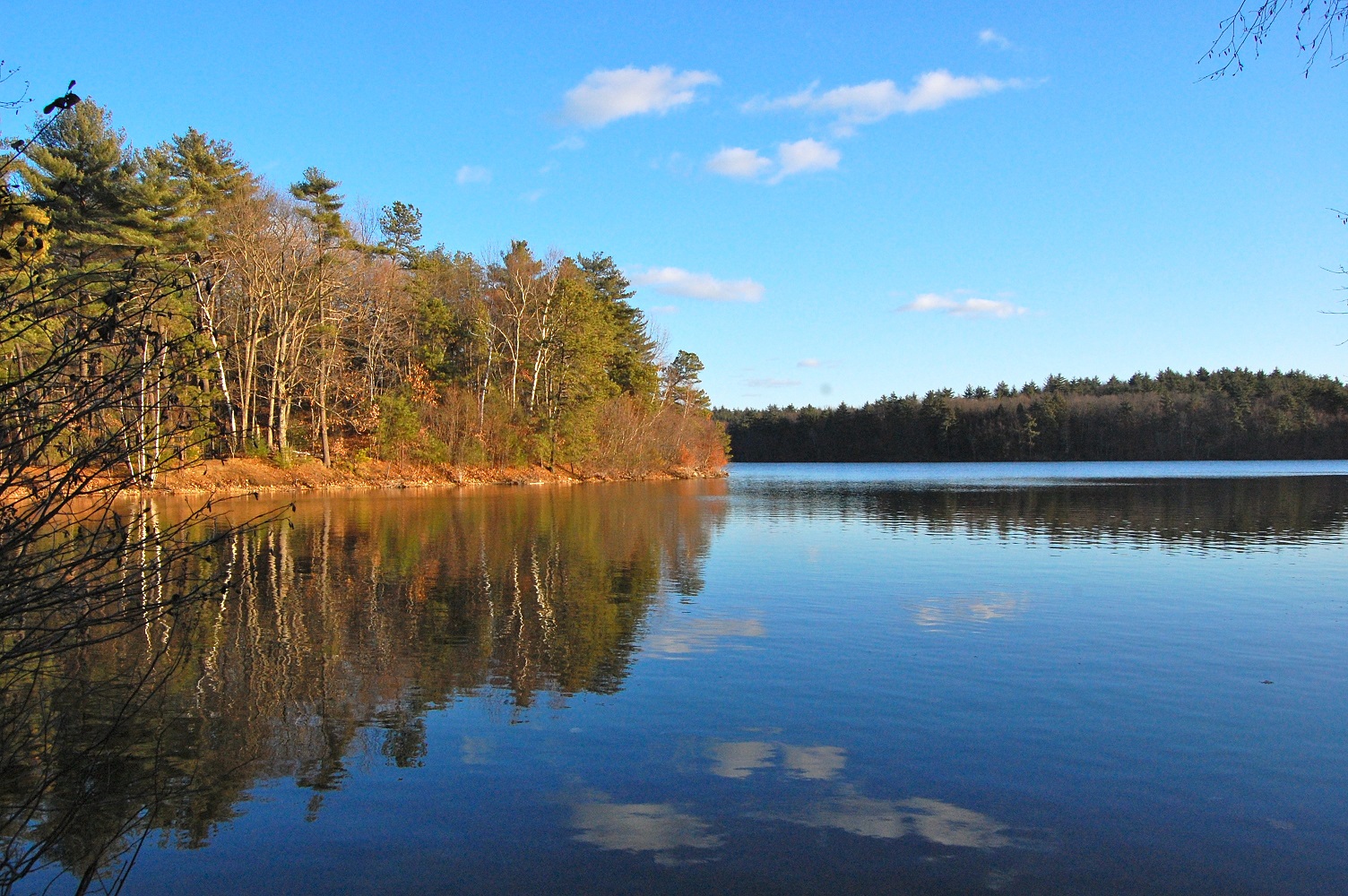 In 1846, Abe Lincoln was first elected to serve Illinois in the U.S. House of Representatives. In that same year, but a thousand miles away, another young man was sitting down to write about his life in a rustic cabin he had built with his own hands. Henry David Thoreau was living outside of the small Massachusetts town of Concord where, 71 years prior, “the shot heard round the world” was fired, marking the first military engagement of the American Revolutionary War. Soon thereafter, George Washington was appointed Commander-in-Chief of the Continental Army.
But by 1846, while farmers still lived in Concord, so did railroad builders, ice harvesters, abolitionists, writers and philosophers. A new, more industrial age was dawning.
Thoreau styled himself as a part-time hermit, availing himself of family and society in the nearby town when he wished, but keenly interested in devoting the bulk of his time to observation of the natural world. He thought it “a soothing employment, on one of those fine days in the fall when all the warmth of the sun is fully appreciated, to sit on a stump… overlooking the pond, and study the dimpling circles which are incessantly inscribed on its otherwise invisible surface amid the reflected skies and trees.”
In other words, before reflecting pools had been invented for the folks in the city, Henry knew how to go find himself a good pond to ponder.
IV. How about a Reflecting Swamp?
After that brief refresher on the salutary effects of the natural world from one of America’s favorite 19th century writers, let’s zoom back to Washington D.C. and the present day to consider what none other than the Jeff Bezos-owned Washington Post has to say about the ongoing Reflecting Pool problem.
Actually, this is coming from WaPo’s Climate Coach advice columnist, Michael J. Coren.
“Forget draining the swamp,” Coren writes. “Restore it.”
He points out that the federal government has fought – and repeatedly lost – its battle with algae in the Reflecting Pool for more than a century. Isn’t it time to take a different approach?
Coren talks with people who, on a smaller scale, have been retrofitting conventional swimming pools into chemical-free natural swimming pools for more than a decade. Biofilters or bioreactors can provide living ecosystems that deprive algae of the nutrients they need to flourish.
The Webber Natural Swimming Pool, a public park in North Minneapolis, is one scaled-up example. And even if this sounds like something of a novelty in the United States, it isn’t in Europe. Across “the pond,” Coren reports, there are more more than 20,000 public and private natural swimming pools in operation.
As a Climate Coach, Coren suggests that it’s time to sign a truce with nature. Let’s reflect on that.
Barbara Lloyd McMichael is a freelance writer living in the Pacific Northwest. Check out her Pacific Rim Story Laboratory website

Barbara McMichael
Barbara Lloyd McMichael is based in the Pacific Northwest and writes about books and culture. She writes a syndicated weekly book review column called “The Bookmonger” that focuses on Northwest books and authors. Her PR for People® Book Review is written exclusively for The Connector.