









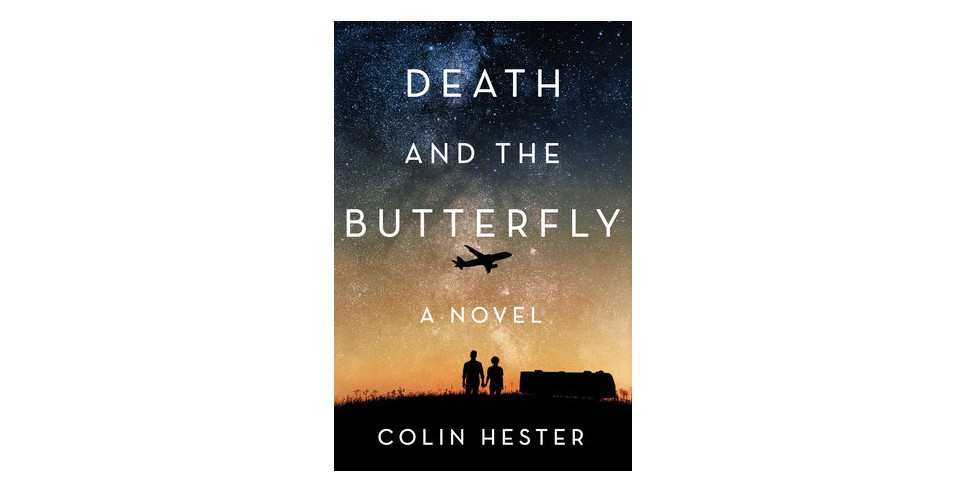
DEATH AND THE BUTTERFLY
By Colin Hester
Counterpoint Press (2020)
pp 264
DEATH AND THE BUTTERFLY cracks open the door and allows us to peer into lives that are far apart in time and culture, yet every character has been touched by the long-term effect of the tragedy of World War II. Three storylines, developed over multiple timelines, are interwoven to create a narrative that is equal parts prose and poetry.
Susan and her brother Phillip are the offspring of an English family who are experiencing the personal costs of war, during a time when World War II is in full swing. In Toronto, many years after the war is over, Polo is a paperboy and would-be poet. And Riordan dishes up the mannerisms, speech, and bluster found among the comradery of contemporary young men living in Montana.
In addition to the three story lines, there are the occasional appearances of Luftwaffe pilots, Winston Churchill, and the English King George VI.
The author’s mastery of language is exquisite, causing the reader to take pause and breathe deeply because mood, culture, and foreboding are always apparent. “Dark as marmite is that rain cloud.” Other descriptions are clever, one-of-a-kind. “He boasted forearms as thick as barrels and wore a rubber apron knotted atrium the girth of an executioner.” And there is no shortage of lean, quirky language. “He sleeked a cigarette case from his suit’s jacket inside pocket and thumbing it open he offered her one.”
“His trousers bunched like cordage behind his knees,” is an example of the delightful slang or colloquial expressions that are prevalent in the English culture. Here is another: “One man stood Kathy a Baileys.” Some of the language is archaic. Words such as Dun-bricked, anneal, weskit and scarper invite a quick look up in the dictionary.
Descriptions of violent sounds are a bit maddening. The “drip drip” of drops, the “Poom! Poom! Poom!” or “Whump-whump-whump” of bombs, and
“the thupp-thupp-thumping” of anti-aircraft guns makes what is horrifying sound trivial and silly.
The author quotes Eliot: “the best way to forge your own heartbreak into art is to steal another’s.” In DEATH AND THE BUTTERFLY there is no shortage of death, sadness, and tragedy. The author succeeds in creating art from what might be his own heartbreak. The liminal space between life and death is captured, and the beauty of both death and the butterfly prevail. The butterfly’s gossamer wings invite transparency, a lightness that rises above despair.

Patricia Vaccarino
Patricia Vaccarino is an accomplished writer who has written award-winning film scripts, press materials, articles, essays, speeches, web content, marketing collateral, and eleven books.